
Tag Archives: Teenspace

Privacy and other issues with Hazel Health telehealth counseling in Chicago Public Schools

Illinois Families for Public Schools sent a letter to the Chicago Board of Education on May 5, 2025 with a list of concerns about privacy and other issues with a new telehealth program where mental health services are provided by for-profit company Hazel Health. IL-FPS urges the Board to answer the questions posed in the letter and revise the consent forms that parents agree to when they sign their student up for services.

The acute need for additional access to mental health services for the students of Chicago Public Schools should not require the young people receiving those services to waive their rights to privacy, nor have their personal information exploited commercially.

You can read the full letter here. The four primary concerns presented include:

  • Only one of two contracts with Hazel Health are available on the CPS website. The list of data collected that is included in one of the contracts does not appear to be complete; it does not list any medical information or video or audio data as being collected, which does not make sense given the nature of the services provided by Hazel Health. Under the Student Online Personal Protection Act, parents and the public should have access to a list of what information is being shared with a third-party company.
  • Pages on the Hazel Health website that parents are directed to include tracking by Amazon and Alphabet (Google’s parent company). This type of commercial surveillance, especially for a site providing mental health services, is not acceptable.
  • The terms in the consent/authorization form that parents agree to in order to sign students up for services are deeply problematic and conflict with state law and CPS policy. Among other things, parents agree that data shared with Hazel “may not be secure and may be illegally accessed by a third party” and that their child’s information can be used for commercial and research purposes.
  • Online job review sites report that caseloads for Hazel Health therapists may be up to ten clients per day or 35 clients per week. This raises issues about working conditions for clinicians and the impact of that on the students who are receiving services.

The questions for the Board posed in the letter are:

  1. What data elements of students’ covered information are being collected, transmitted and held by Hazel Health and its subcontractors?
  2. What student records and covered information generated in the course of receiving services from Hazel Health are shared back to CPS? Which CPS employees have access to them? Who determines this? How are these student records shared?
  3. How is confidentiality for students aged 12-17 years protected with respect to limitations on parental access?
  4. How many students does one therapist see per day and per week?
  5. How much time do therapists have to prepare for and respond to client sessions?
  6. What, if any, direct, real-time communication takes place between clinicians and school staff?

Illinois Families for Public Schools urges the Board to (i) provide families with answers to all the above questions, (ii) post any and all legal agreements between Hazel Health, United Healthcare (the funder of the current program) and the Chicago Board of Education publicly on the CPS website, (iii) revise and reissue any consent and policy documents that Hazel Health requires families to agree to in order to for children to access services, and, if needed, renegotiate any agreements with Hazel Health to ensure that no student information or records provided to or processed by them will be used for anything other than providing telehealth services.

New York City rolled out a telehealth mental health program last fall that was a contract between Talkspace and the city’s Department of Health that has been widely promoted by the NYC Department of Education for public school students there as well. It has had major privacy issues (see here and here) flagged by the Parent Coalition for Student Privacy and other privacy advocates. Ultimately, the contract between NYC and Talkspace was rewritten, but problems with tracking users on their website have yet to be resolved.
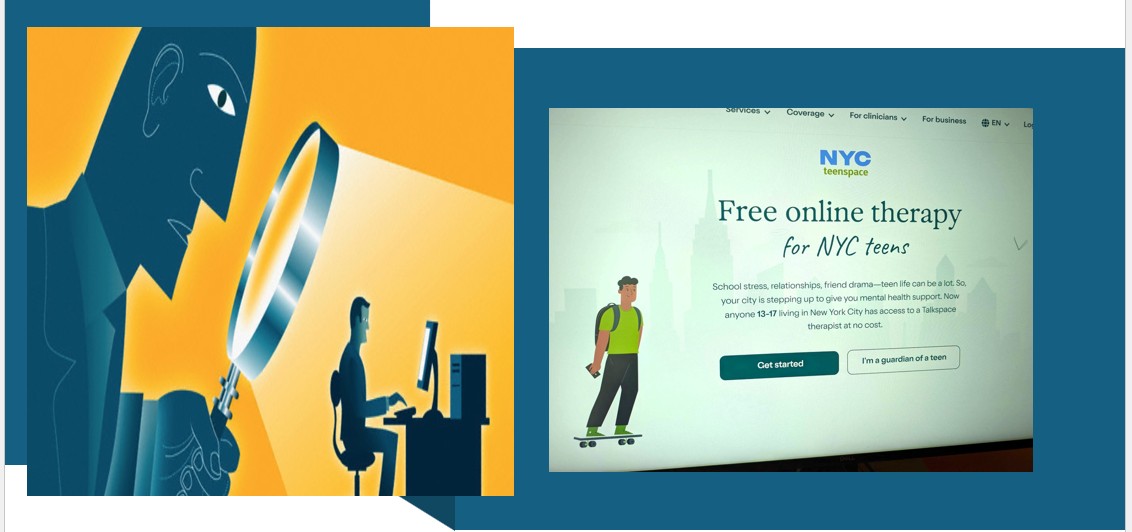
Continuing Teenspace privacy violations, despite assurances from city

January 8, 2025

Below is the letter PCSP, NYCLU and AI for Families sent yesterday  to the NYC Department of Health, in response to their latest letter dated Dec. 18, 2024.

We were happy to learn that the Department of Health and Mental Health (DOHMH) is now requiring Talkspace to rewrite their contract providing online mental health services for NYC teens, as well as their Privacy Policy and Terms of Service to be more privacy protective, in response to the concerns we expressed on September 10 and October 17, 2024.

Yet we find the DOHMH claim in their latest missive that the Talkspace/Teenspace website has now eliminated the use of invasive ad trackers, cookies and personal information disclosures to social media platforms to be wholly inaccurate.

In this follow-up letter we discuss our findings and continuing concerns.  We urge DOHMH to make more effective efforts to protect the privacy of NYC teens, including requiring Talkspace to build an entirely new website dedicated to NYC Teenspace services, free of trackers and disclosures, and that it undergo a privacy audit before making it live.

Talkspace should also be required to delete all the personal information already illegitimately collected and shared of NYC children, and make an apology and recompense to those families whose privacy was violated.  We also ask why if Talkspace has violated its original contract as DOHMH has implied, whether they will be fined or suffer any penalty.

NYCLU PCSP AIF Reply to DOHMH re persistent privacy issues w. Teenspace 1.8.2025

Council hearings and testimony on student mental health & Teenspace

Video above of CM Joseph’s incisive questioning of Marnie Davidoff, Assistant Commissioner for the Bureau of Children, Youth and Families about Teenspace lax privacy practices, followed by video of Leonie Haimson, Parent Coalition for Student Privacy, speaking on the same issue.  Leonie’s written testimony is below, followed by the testimony of Shannon Edwards, founder of AI for Families.  Chalkbeat and Crain’s Health Pulse also reported on the issue.

Council testimony about teenspace 11.25.24 Mental Health Testimony_S.Edwards 11.24.24

Our follow-up letter to the City, reaffirming our concerns with Teenspace violations of student privacy

Oct. 17, 2024

On Sept. 10, along with NYCLU and AI for Families, we wrote the Mayor, the DOE Chancellor, and the Commissioner of  Health about our deep concerns with the way in which the online mental health company Teenspace allows for the sharing of personal information with unnamed third parties for marketing purposes in a manner that would be illegal if the contract was signed by the DOE rather than the Dept. of Health. Their parent company, Talkspace, is being paid $26 million over three years by the city to provide free counseling to students, and the Mayor, the Commissioner of Health and the DOE have all been aggressively encouraging NYC students to sign up for these services, with no mention of how their personal data may be used for predatory marketing and other commercial purposes which could further undermine their mental health.   More on this here.

On Sept. 23,  Dept. of Health responded, arguing that they did not have to abide by the state student privacy law since they were not an education agency, but assuring us that their contract was no less  protective.  On Oct. 8,  we received the Talkspace contract via a Freedom of Information Law request.

The contract did not dispel our concerns.  Since we sent our initial letter, we had discovered that when a NYC student visits the Teenspace website on their phone, their personally identifiable information is shared with 15 ad trackers and 34 cookies, as well as Facebook, Amazon, Meta, Google, and Microsoft among other companies, which we saw from using the Blacklight  privacy audit tool. These findings were later confirmed by a security company that does privacy analyses.  These findings are particularly concerning, given how the city is suing many of these companies for undermining children’s mental health and designing their platforms to be addictive  in order to maximize their revenues via targeted advertising.

Our follow-up letter to the Dept. of Health is  here and below, copied to  other city officials.  If you’d like to hear more about Teenspace and other threats to student privacy, please attend our privacy briefing on Wed. October  23 at 7 PM EST; you can register here.

NYCLU PCSP & AIF response to DOHMH regarding Teenspace privacy violations 2024.10.16