See alsos articles in the media in the Daily News here, Gothamist here, and again in the Daily News here.
FOR IMMEDIATE RELEASE; 3/24/2026
Media contact:
Edgar Alfonseca, NYC-DSA, tech.action@socialists.nyc, +12015891241
Liat Olenick, Climate Families NYC, Liat@climatefamiliesnyc.org, 917-930-2788
Kelly Clancy, PhD, PACES, parentsforaicaution@gmail.com, 512-589-6302
Martina Meijer, MORE-UFT, more@morecaucusnyc.org
New York: In response to the guidance on A.I. in schools released today, the AIM Coalition including NYC-DSA Tech Action, Climate Families NYC, Alliance for Quality Education, Parent Coalition for Student Privacy, MORE-UFT, the Coalition for Racially Just Public Schools, Class Size Matters, Parents for AI Caution and NY Kids PAC released the following statement:
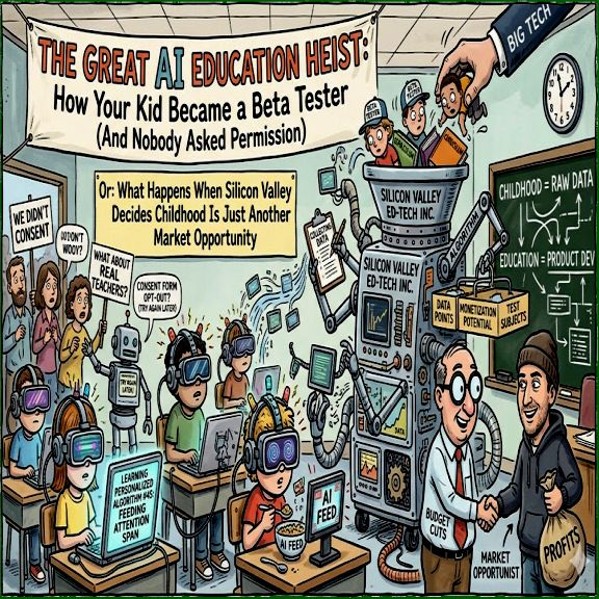
The one indisputable statement in the AI guidance released by the Department of Education today is that ‘The long-term effects on how children learn,think, and develop in the era of AI are not fully understood. No school system in the world has accounted for all the implications.’ It is for this reason that more than 1500 parents and educators have signed our petition calling for a moratorium on its use, and the reason five Community Education Councils have approved resolutions in support this moratorium – to prevent the multiple, serious, and documented risks to children, including the growing evidence that its use in the classroom undermines student privacy, cognitive development, creativity, mental health and the environment.
As a coalition of parents, advocates, educators and community leaders we reject the DOE’s sham 45 day process and inadequate, cramped survey for what is clearly a foregone conclusion to embrace big tech at the expense of our students. We call on Mayor Mamdani to act immediately in alignment with his own commitment to parent and community involvement as well as green and healthy schools and declare a moratorium on any implementation of AI, while holding in person feedback sessions to hear our concerns and those of the other members of the NYC Public School community.
“The DOE is exposing kids to AI without any protection, let alone real understanding of impact on student learning, privacy, emotional health, equity or algorithmic bias. This is a reckless decision, making children guinea pigs when we should be acting carefully and judiciously,” said Zephyr Teachout, Professor at Fordham Law School.
Said Katie Anskat, high school teacher and UFT member, “This guidance creates a structure where authority is centralized but accountability is pushed down to the school level. The DOE determines which AI tools are approved and sets systemwide rules, but the responsibility for how those tools are used is placed on educators and leaders in individual schools. By requiring human judgment, oversight, and review in all cases, the policy ensures that when something goes wrong, whether it is inaccurate information, bias, or a privacy issue, the burden falls on school based staff rather than the system that approved and promoted the tool.“
“I and other parents do not want taxpayers paying AI companies for products that use the data from our students and teachers to enhance their own bottom line. It’s predatory,” said Shannon Ritchey, a District 14 parent.
“We are pleased to see that NYCPS acknowledges the potential harms of AI, and has prohibited its use to create IEPs. However, the guidance admits that further evaluation is needed to assess the risks of various AI products with regard to algorithmic bias, negative impacts on instruction, inequitable outputs, and more. DOE must first assess these products before recommending them to be used with any students in NYC schools. NYCPS must take more intentional steps towards engaging families and other stakeholders in these conversations, and we look forward to more in-depth community involvement in this ongoing process. In the interim, we will continue our call to pause the use of AI products in our schools,” said Smitha Varghese Milich, Senior Campaign Strategist of the Alliance for Quality Education
“Unregulated Big Tech AI companies are on the verge of convincing the Mamdani NYC government to spend precious public tax dollars on their anti-democratic, pollution-generating, and education-undermining AI products. Just like renters had a meaningful opportunity to inform housing policy in the Rental Ripoff Hearings, NYC parents deserve the same level of care and investment to have a genuine opportunity to influence AI policy in NYC schools. Mayor Zohran Mamdani must listen to the advocates and immediately instruct Chancellor Samuels to impose a two-year moratorium on the use of all AI products that are currently unregulated and pedagogically untested and could cause untold damage to 900,000 public school students,” said Edgar Alfonseca, NYC-DSA Tech Action Working Group & NYC-DSA Comrades with Kids.
“This guidance is confusing, contradictory in many places, and doesn’t address most of the serious concerns of parents and teachers. The existing privacy practices of the NYC Department of Education have been shown to be ineffective as evidenced by repeated student data breaches. The ERMA process outlined in the document is nothing but a checklist that companies have often abused without sufficient verification or oversight by the DOE privacy office. For example, some of the AI products currently used in schools data-mine student information to improve their products according to their Privacy Policies, a practice specifically outlawed by the NY State student privacy law. Others collect biometric data which the State Education Department has said should not be allowed without parent input – though parents have denied any voice in their use. To make things worse, this document has been released without any feedback from the Chancellor’s appointed AI Working Group, despite repeated promises to the contrary, and despite Mayor Mamdani’s vow to strengthen parent and community collaboration, “ said Leonie Haimson, co-chair of the Parent Coalition for Student Privacy.
“AI is driving climate collapse and global water bankruptcy. If the largest school system in the country uses its purchasing power to fuel more reckless and dangerous AI expansion, what future are we preparing our kids for? Mayor Mamdani made a commitment to Green and Healthy Schools for all NYC children. Fueling climate collapse at the expense of student privacy, mental health and ability to learn is the opposite of that commitment. Parents and students deserve concrete answers and real engagement not vague platitudes about the environment and listening to stakeholders. And our children deserve leaders who will use their moral authority to protect them, not corporate apologists who subject them to a surveillance experiment that will leave them a world on fire,” said Liat Olenick, MsEd, Public teacher and parent, Program Director, Climate Families NYC,
“The guidance document continues to allow the classroom to be the Wild West in terms of how AI is used for student learning. It contains assertions about how AI can improve learning for students and prevent cognitive offloading, but there is no research behind these claims. Importantly, they quote from the Brookings report, but miss the most important conclusion:”at this point in its trajectory, the risks of utilizing generative AI in children’s education overshadow its benefits. This is largely because the risks of AI differ in nature from its benefits—that is, these risks undermine children’s foundational development—and may prevent the benefits from being realized,” said Kelly Clancy, PhD, Parents for AI Caution in Educational Spaces, D20 CEC.
“CECs from across the city have passed resolutions calling for a moratorium on AI to protect student learning and have asked to meet with the chancellor. Despite the Mayor’s campaign promises to listen to parents, those requests have been ignored, and it’s clear from this document that the DOE is failing to listen to the concerns parents have about AI in the classroom. The lack of any engagement with CECs on this issue before releasing this document makes the failure of mayoral control clear. Parents need real decision making power over decisions like this that affect their children’s lives,” said Alina Lewis, member of the CEC in District 20, which passed a resolution in favor of the moratorium.
“The MORE-UFT caucus sees the encroachment of AI into our schools as a labor issue. Educators face an unsustainable workload, and AI is not the solution to this problem. The AI guidelines fail to address the resistance from parents, students and teachers related to a myriad of concerns. These concerns include the impacts of cognitive offloading, the deskilling and deprofessionalization of teaching, the horrific environmental impacts of AI, racism embedded into the programming, and the connections of the supply chain to enslaved labor and environmental racism. The data “protection” is the same (ERMA) that the DOE uses now, and it’s not effective. We have seen far too many data leaks and a lack of accountability for the corporations profiting off of educator and student data, said Martina Meijer, teacher, MORE-UFT.
“Goals like ‘responsible AI integration’ are meaningless. Is there any responsible way to use a technology that’s fundamentally unaccountable, prone to racial & gender bias, emotionally manipulative, environmentally disastrous, and frequently wrong?” asked Craig Garrett, parent and SLT member, District 14 .
“Science has a growing body of work on the harms of the use of AI on the brain, physical and mental health, bias of racial groups, and hallucinations resulting in cognitive decline in children and adults. Giving our vulnerable communities a faulty narrative on the so-called benefits of AI because the Department of Education doesn’t want to admit to harms they are already exposing children to is negligent and irresponsible. More and more parents and educators are asking for a moratorium on the use of AI in classrooms as we don’t have guardrails put in place. While we should be providing opportunities for our students to learn and understand engineering, technology and science, we should not be doing it at the expense of their cognitive development and their abilities to be problem-solvers, critical thinkers and innovators,” said Kaliris Salas-Ramirez, PhD, neuroscientist, medical educator and parent leader in East Harlem.
###